

Rewrite the
Exposure to air pollution in early life could have lasting effects on child development and mental health in adolescence, according to our recent study.
We integrated air pollution data with existing longitudinal data from the Christchurch Health and Development Study (CHDS). The CHDS has followed more than 1,200 children born in the city in 1977, with a strong focus on developmental and mental health outcomes.

Our aim was to examine how exposure to air pollution shapes development and mental health in later childhood and adolescence. We found an increased risk of attention problems, conduct issues, lower educational attainment and substance abuse in adolescence associated with higher exposure.
Existing evidence often focuses on adulthood. However, by tracking air pollution exposure from the prenatal period to the age of ten, and linking this data to subsequent cognitive and mental health outcomes, we were able to highlight the long-term consequences of growing up in polluted environments.
Air pollution is one of the leading environmental contributors to disease, especially respiratory and cardiovascular conditions. Children are especially vulnerable to air pollution because their brains and bodies are developing.
A growing body of evidence suggests air pollution could affect brain development, educational attainment and mental health, contributing to depression, anxiety and conduct or attention problems. Despite this, few studies have tracked long-term exposure to air pollution from early childhood.
Patterns of exposure
We chose to conduct this research in Christchurch because the city is a historical air-pollution hotspot, with a documented history of measurements, and because of its long-running birth cohort study.
The CHDS collects detailed information on participants’ health, development, education and family backgrounds from prenatal into adulthood.
Flickr/Larry Koester, CC BY-SA
For this study, we linked historical air-pollution data, measured as the concentration of black smoke from 1977 to 1987, to residential locations of birth cohort members. This allowed researchers to estimate each child’s annual exposure to air pollution during key developmental periods.
We found four distinct patterns of air-pollution exposure across childhood (see graph below):
-
consistently low (these children had the lowest levels of air pollution throughout childhood)
-
consistently high (this groups had the highest levels of air pollution from birth to the age of ten)
-
elevated preschool (exposure peaked between ages three to six and then declined)
-
high prenatal and postnatal (high exposure before and immediately after birth, but declining later).
We then examined whether children in the higher exposure groups were more likely to experience adverse impacts on cognition, educational achievement and mental health in later childhood and adolescence.
We adjusted for a range potential confounders such as socioeconomic status, neighbourhood disadvantage and parental characteristics.
We found children with elevated pre-school exposure had poorer educational attainment and a higher likelihood of conduct disorders and substance abuse problems. High prenatal and postnatal exposure was linked to a greater risk of attention problems as well as substance abuse in adolescence.
Children with persistently high air-pollution exposure were more likely to develop attention problems and had higher odds of substance abuse issues in adolescence.
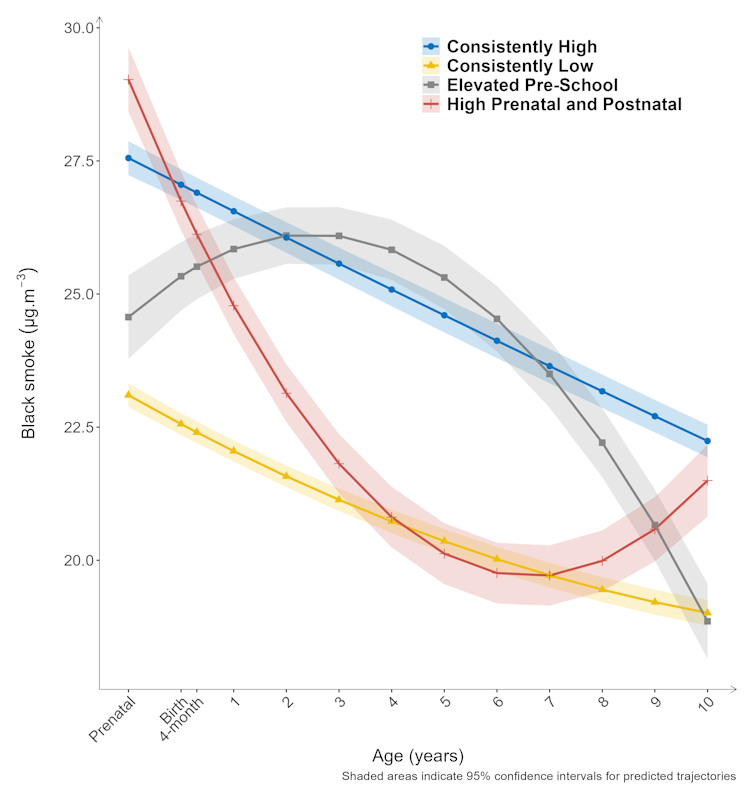
Author provided, CC BY-SA
What these findings mean
The effects of air pollution on several outcomes were small at an individual level, but they could be highly important at a population level.
This is because even small shifts in cognitive and mental health outcomes, when applied to entire populations of children exposed to poor air quality, could have major consequences affecting future educational achievement, workforce productivity and public health burdens.
These findings support previous research suggesting air pollution could affect brain function by causing inflammation, oxidative stress and affecting neurodevelopmental pathways. Importantly, they reinforce the idea that certain developmental periods, such as the prenatal period and early childhood, may be especially sensitive to pollution exposure.
We need further research to confirm our findings but potential considerations include reducing children’s exposure to air pollution and improving urban air quality by cutting emissions from vehicles, industry and residential heating.
We should also promote cleaner energy sources to decrease exposure to harmful pollutants such as nitrogen dioxide and fine particulate matter. Providing better access to green spaces may mitigate the impact of air pollution.
To strengthen public health and policy measures, we need stricter air quality regulations, particularly around schools and childcare centres. We should also implement air-quality monitoring in urban areas to identify high-risk zones for children.
Better public information is crucial to minimise indoor and outdoor pollution exposure. This could include the use of air purifiers for indoor activies or limiting outdoor exposure during peak pollution periods.
Further research and action
Our study highlights the need for more research on air pollution’s effects on children’s mental health and cognition, particularly in different environmental and socioeconomic contexts.
Policymakers, educators and healthcare professionals must consider air pollution as a potential risk factor for developmental challenges, not just a physical health concern.
Air pollution may not be visible in the same way as poor housing or inaccessible healthcare, but its impact on child development could be important at a population level.
Given the rising prevalence of mental ill health in young people and adults, tackling air pollution could be an overlooked but essential public health strategy for protecting future generations.
in HTML format to be seo optimized related to this title
Early exposure to air pollution could affect brain development and mental health later in life: new research
. Create appropriate headings and subheadings to organize the content. Ensure the rewritten content is approximately 1000 words. Ensure to strip all images from final output i dont need images.At the end of the content, include a “Conclusion” section and a well-formatted “FAQs” section.Ensure there are no additional notes and introductory text in the final output.Final output is gonna publish directly as post content so keep in mind provide only rewritten post content without any introductory text or notes in result and kindly dont explain what you done or what you provided as output of this prompt
Recommended Products:
-

Krill Oil Omega 3 Supplement, Antarctic Krill Oil 1250 mg with Astaxanthin & Omega 3 Fatty Acid Supplement, High DHA & EPA Concentration for Brain & Joint Health Support, No Fish Burps (60)
$1,999.00 Buy Now -

Carlyle Bacopa Monnieri Capsules | 180 Capsules | Gluten Free Supplement
$15.28 Buy Now -

Anxie-T – Stress Relief Supplement – Supports Mood & Mental Focus – Feel Calm and Relaxed – Eases Tension & Nervousness – Ashwagandha, Kava Kava, GABA & L-Theanine – 60 Capsules
$32.99 Buy Now