

Rewrite the
Virtual Beauty is the summer show at Somerset House, London, featuring a fascinating collection of visual work by artists dealing with the connection between technology and beauty. As you might expect, it focuses on the human form and the reshaping of the body and face through computational processes.
While humans have contemplated their self-image through mirrors and pictures of themselves for hundreds of years, digital inventions have reconfigured all this. Today, people regularly use mobile phone screens as mirrors and the camera to record themselves. Posting these images online only affirms that identity to their wider community and networks.

The rectangular shape of a phone screen is used extensively in the exhibition by digital artists to show the new malleability of human identity and how we can reimagine ourselves through digital technologies.
The artist Orlan, for example, conducted cosmetic surgery and recorded it live on video, originally live-streaming it into galleries in 1992. Astonishingly in the video she is seen awake and even discussing the aesthetics of her facial surgery with special guests while the surgeons work with a scalpel on the dotted lines on her face.
But today you don’t need a surgeon to change your image, you can use your phone and apps to “try out” new identities. This is our new digital world and the questions about what these processes mean is what concerns the artists here.
In visual anthropologist Mathilde Friis’s excellent accompanying essay to the exhibition From the Selfie to the Avatar: Beauty, Bias and the Digital Self, she suggests that the actual body no longer limits beauty thanks to our online lives.
In this online presentation of self, she argues, is a tension between our offline identity, the facets of ourselves we inherit and literally inhabit, and the freedom to escape these fixed features in how we present ourselves online.
Do you want to look like a well known model, an exotic anime character or something else? These are all possibilities in the digital world, but what kind of change do they represent? Such are the lingering questions for the viewer at the exhibition.
The artworks explore the trials and tribulations of identity and its relation to traditional notions of beauty and attempts at liberation from them. This point is strongly made in Filip Custic’s installation Pi(x)el (2022), where a 3D silicone mannequin has tiny screens attached in front of the key features of the body.
The screen images flicker between different images of eyes, ears, mouth, nose, genitals and fingernails to demonstrate the potential choices one might make to change them.
Qualeasha Wood/ Pippy Houldsworth Gallery London
I was particularly drawn into Qualeasha Wood’s intriguing textile work It’s All For U (If U Rlly Want It), (2024). The tapestry looks like a photo-collage. At the centre is a black woman who reaches towards a phone screen.
Around her are the tools used to construct the digital self, the phone camera the screen of the selfie, its menu buttons, texts and her hand that taps out this creation. These facets are all beautifully scrambled together into a single work that invites the viewer to linger and meditate on them.
At the same time the many artworks that do use screens tend to play with traditional expectations of them. Some of these images can seem uncanny or confronting while other conform to more traditional ideas of what a digital avatar can be.
An example of one of these works in Angelfire’s XENA (2021), which is inspired by the TV series character Xena: Warrior Princess (1995-2001). This take on the character shows a powerful hyper hybrid figure, a kind of masculine and feminine, neither firmly one nor the other and maybe not even both.
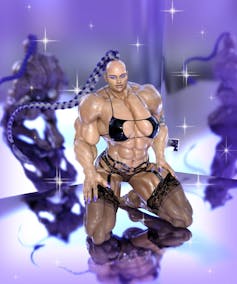
Angelfire
Another is Lil Miquela’s Rebirth of Venus (2020), which presents a virtual figure who looks like a real person. Beautiful butterflies fly around and settle on her, as if to emphasise her beauty. Although Lil Miquela does not exist beyond her digital space, she has a massive following online as a viral influencer as well as a virtual avatar.
The exhibition is a welcome engagement with ideas of virtual beauty and into the growth of digital identities that are at once a part and separate or different from our offline selves. It shows how hybridity is a feature of virtual space and how we tend to sometimes subtly merge our own ideals with the computer images that we see.
It has been said that photography and cinema had a similar effect during the 20th century. The exhibition also offers great insight how these virtual spaces have allowed people to present identities online which might be challenged offline.
All in all, its is an interesting presentation of the tension between the animation of new selves and the palpable anxiety and questions about where we are all headed.
Virtual Beauty is on at Somerset House in London until September 28 2025

Looking for something good? Cut through the noise with a carefully curated selection of the latest releases, live events and exhibitions, straight to your inbox every fortnight, on Fridays. Sign up here.
in HTML format to be seo optimized related to this title
Virtual Beauty exhibition – is our sense of beauty changed by new technologies?
. Create appropriate headings and subheadings to organize the content. Ensure the rewritten content is approximately 1000 words. Ensure to strip all images from final output i dont need images.At the end of the content, include a “Conclusion” section and a well-formatted “FAQs” section.Ensure there are no additional notes and introductory text in the final output.Final output is gonna publish directly as post content so keep in mind provide only rewritten post content without any introductory text or notes in result and kindly dont explain what you done or what you provided as output of this prompt
Recommended Products:
-
Sale!

HERBAL HILLS Bitter Melon/Bitter Gourd/Karela Powder (Momordica Charantia) | 16oz (454 GMS) | Best for Eye & Skin Health
Original price was: $47.48.$9.99Current price is: $9.99. Buy Now -

Gel Multi-Attivo Protetivo Aloe Vera Dermo ml, Multi-Colour, Lavender, 15
$21.49 Buy Now -

Source Naturals Glucosamine Sulfate, Sodium-Free Powder for Joint Support – 16 oz Powder
$20.07 Buy Now